


The raging fireball raced wildly down the road, zigzagging its way around the mid-morning traffic. Its flames licked the dry Tunisian air, dancing frantically as a crowd of horrified passers-by rushed to extinguish it.
The fireball had started out as a young man – a 26-year-old street vendor named Tarek Bouazizi; a man who had been systematically and repeatedly harassed by local government officials for not holding a permit (despite there being no legal requirement to possess one); a man who, in the simplest of terms, had had enough.
Tarek had started his working day at 8am on the morning of the 17th December, 2010. He’d pushed his small wheelbarrow of produce – all purchased on credit – to the busy strip, ready to use his gift of the gab to drum up some much needed business to feed his children.
Just after 10.30am, however, the usual faces joined him to throw a spanner in the works.
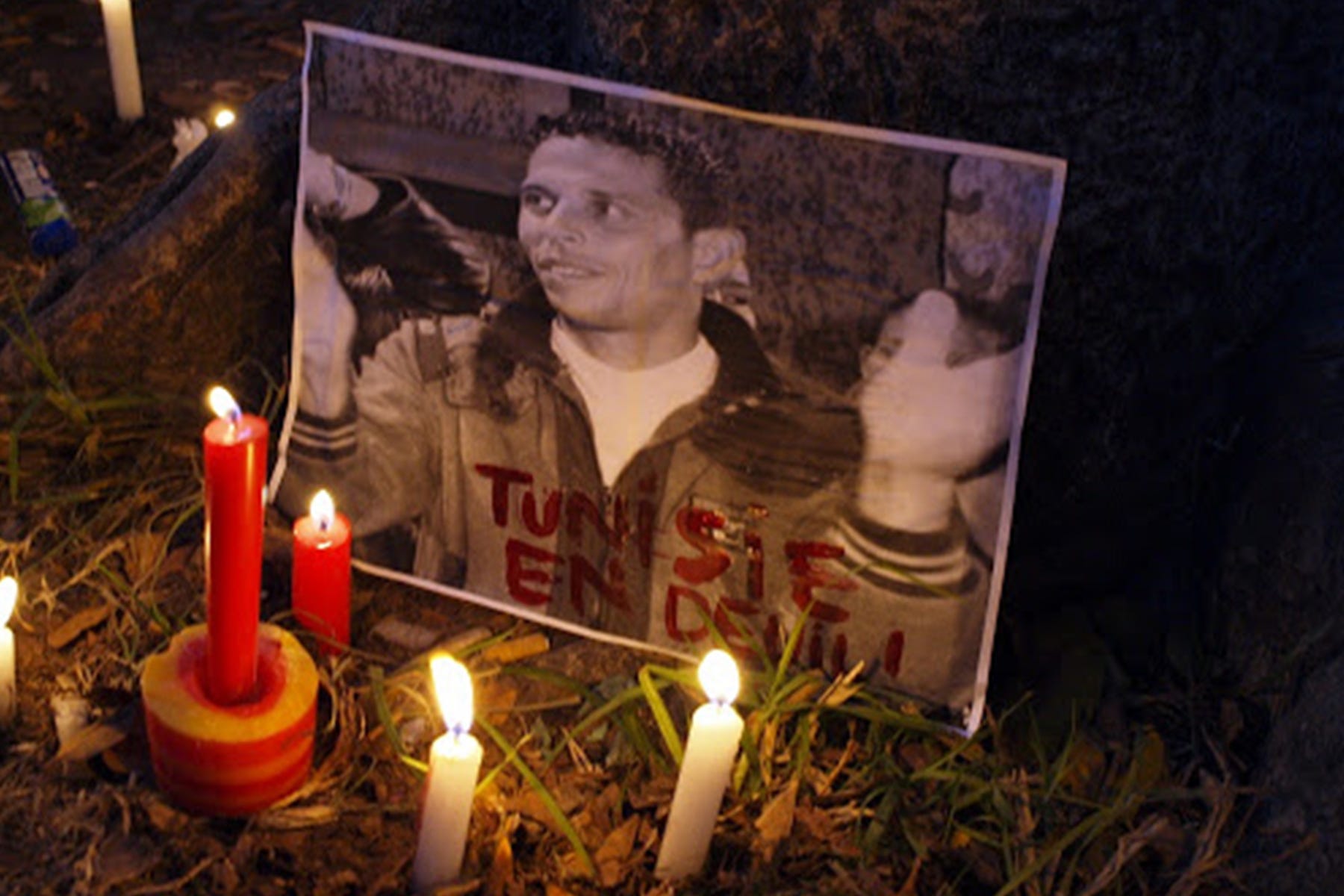
Led by a 45-year-old female municipal officer, Faida Hamdi, the group of smug power-abusers demanded a bribe. But Tarek, who had been financially bled dry over the past two years by bent officers who preyed persistently on vulnerable vendors like himself, was skint.
Angered by his lack of cooperation, Faida slapped him hard in the face, spat at him, confiscated his electronic weighing scales, and tipped up his fruit cart, spilling Tarek’s sole equity onto the dirty street.
Publically humiliated, Tarek marched to the nearby Governor’s office to protest and to ask for his scales back. The Governor refused to hear him, even after the exhausted and mentally-drained Bouazizi was quoted as saying “If you don’t see me, I’ll burn myself”.
Humiliated, rejected, and degraded even further, Tarek walked over to a nearby petrol station where he acquired a can of gasoline before returning to the busy street outside the Governor’s office. As he took his place in the middle of traffic and shouted “How do you expect me to make a living?”, a small crowd of onlookers excused him as just another citizen aimlessly venting his frustration at the corruption of Tunisian power.
But when Tarek had said he’d had enough, he’d meant it.
Dousing himself in petrol, at around 11.30am, less than an hour after the initial altercation, the young man pulled out a small box of matches, struck one, and set himself ablaze.
As he raced screaming down the road, people immediately began to panic. One of them, a stunned bystander, tried to put him out with water, only worsening the situation, and sending the flames to shoot up even higher.
Collapsing on the hot sticky road, Tarek was eventually rushed to hospital where it was discovered that over 90% of his body had suffered extreme burns.
He spent weeks in hospital, was transferred multiple time.
On the 31st December, 2010, doctors at the Ben Arous Burn and Trauma Centre reported that Bouazzi was in a stable condition and was showing signs of potential recovery.
Despite the optimistic prognosis, however, Tarek remained comatose during his entire stay, and on the 4th January, 2011, at 5.30pm local time, the downtrodden street vendor’s act of self-immolation finally claimed his life.
The young man’s death, however, would not entirely be in vain. For decades, the people of Tunisia had shared Tarek’s frustrations and now saw his public protest, his shocking self-sacrifice, as a signal to rise up. That single flame struck from a match would stir not only a nation, but would unite millions of people all over the world – fed up with their corrupt governments and poor standards of living.
Over 5,000 Tunisian citizens felt moved enough by Tarek’s martyrdom to join his funeral procession, many chanting angry slogans and promising that he’d be avenged.
Over the proceeding weeks, more angered protestors would follow in his footsteps, setting themselves alight in a united extreme demonstration against their oppressors.
That single act – the striking of a match, the human fireball scorching its own path across a busy road, would – rather than simply stopping traffic – go on to become the catalyst that would spark the Muslims of the Middle East into rising up against their ‘ungodly’ rulers, in what would become forever known as the Arab Spring.
Riots and violent protests erupted on a mammoth scale; bound and strengthened greatly by the recent rise of social media. Riots in Tunisia. Riots in North Africa. Riots across the entire Arab world.
A humble fruit seller who now lay in a single tomb surrounded by cacti, olive, and almond trees in a small village, had galvanised the frustrations of the Muslim youth into a widespread revolutionary and deadly movement that would change the course of political history.
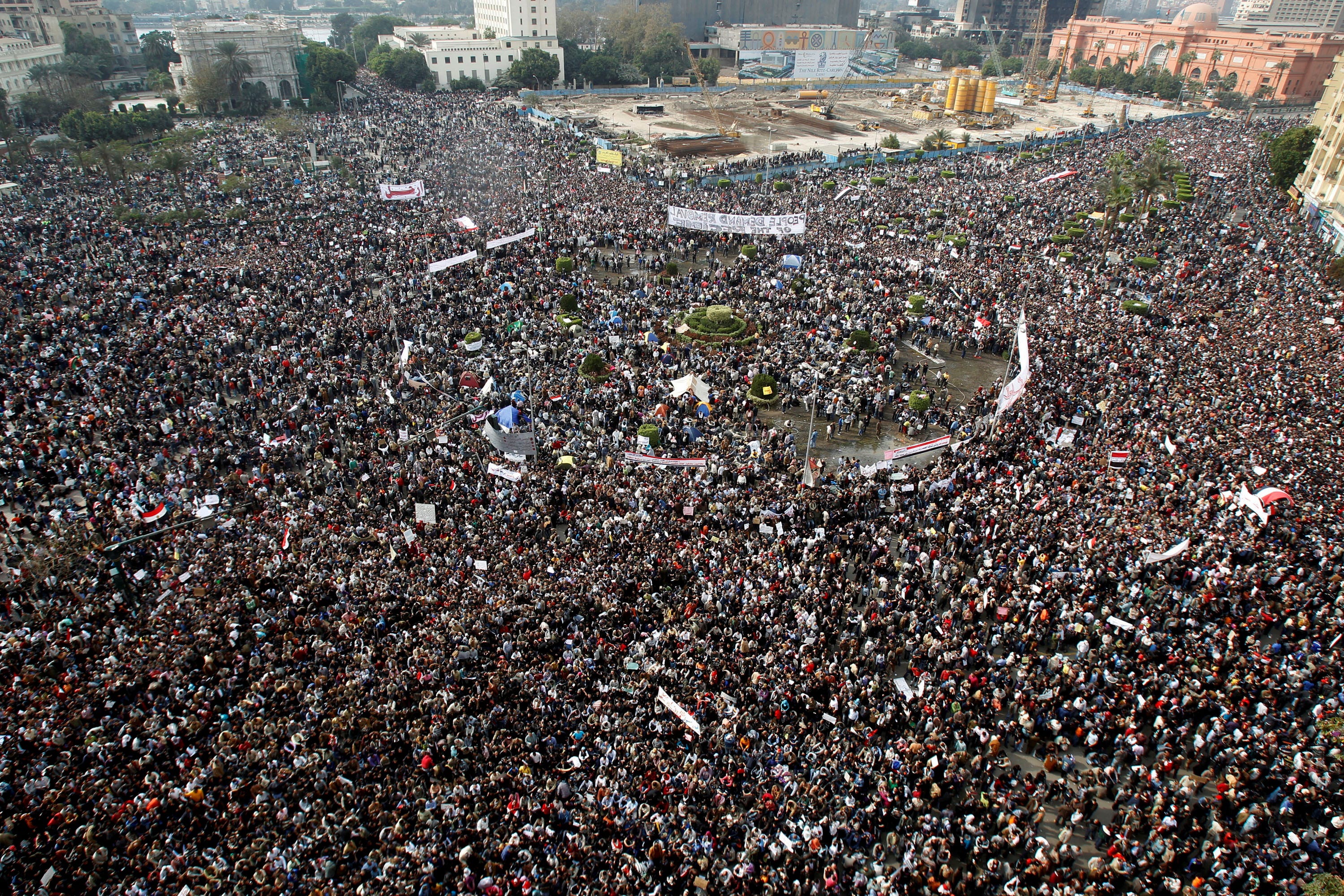
In the six months immediately after Tarek’s suicide, at least 107 Tunisians tried to kill themselves through self-immolation. In Egypt, Abdou Abdel-Moneim Jaafar, a 49-year-old restaurant owner, set himself alight in front of the Egyptian parliament. His act – influenced by Tareks – helped instigate weeks of violent protests across Egypt, and, later, the resignation of Egyptian President Hosni Mubarak.
Ripples from the Arab Spring can still be felt in countries across the modern world, particularly in Europe, a continent that few suspected would experience any adverse effects from the Muslim uprisings, but that in fact curiously sustained deep wounds that it continues to struggle to bare let alone hope to heal anytime in the foreseeable future.
A whirlwind of future-altering events transpired as a direct result. Regimes have fallen. Governments have collapsed. Global terrorism has broadened its appeal, plumped-up by the rising millions of Muslim revolutionaries and their twitching ‘piece of the action no matter the cause’ understudies.
Religion has since been folded into the mix, creating a hostile blend of politics and extreme faith.
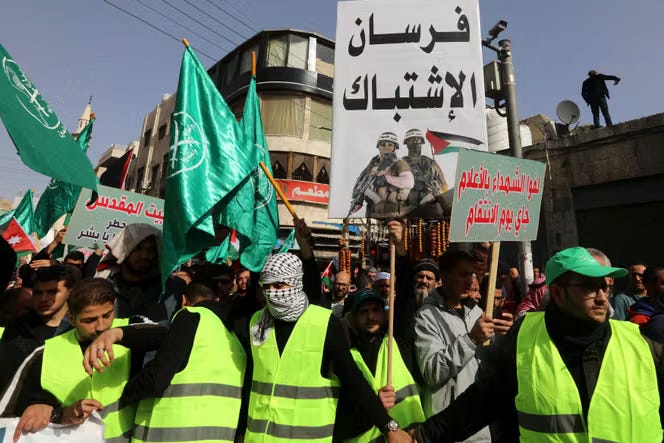
The subsequent unrest has been exploited by Jihadists. In Egypt, The Muslim Brotherhood – an extreme Islamic political movement – has taken a strong hold on power, using its newfound prominence to further spread its influence and ideology across the earth, recruiting every rebel and spirited revolutionary along the way.
Dalia Ziada, a leading Egyptian human rights activist, socio-political analyst and writer championing women’s rights and liberal democratisation, is far from complimentary of the Muslim Brotherhood and how it has helped to reintroduce radical Islam into the country she is proud to call home.
I caught up with Dalia in the summer of 2017. A devout Muslim herself, she was warm, down-to-earth, friendly and more than happy to spill the beans on why she believes that the Muslim Brotherhood should be classed as a terrorist organisation.
Her important work, however, is far too extensive to include here as mere excerpts, for it truly warrants a book or two of its own. I have however, with her express permission, included two of her vital reports at the back of this book for further reading.
With entire countries – some extremely wealthy – rendered weak, vulnerable and unstable following endless revolutions, uprisings, and the overthrowing of dictatorships (the murder of Gaddafi in Libya being a perfect example), militant Islamist groups such as the Muslim Brotherhood, Boko Haram, and even ISIS, have been able to muscle their way in and take full advantage of the volatile situation that had unbelievably been born from a single matchstick.
We westerners are guilty of neglecting to see it coming. We’d seen it before – not least of all in Afghanistan. We should have already long ago learned our lesson. The job isn’t simply done the minute the white flag of the enemy is waived. There must always be a contingency plan, as much effort placed into the aftermath of an ‘intervention’ as there is to the war itself, if not more. They form two parts of the same end game, with both elements deciding the probability of success for the other – two strong legs to help the foreign country shake off the devastation left by its oppressors, to stand proud and build towards a better future. But – for one (often immoral, financially-driven) reason or another, this strategy is seldom, if ever attempted by Western forces.
It is because of this trend that the Arab Spring devolved into the Terrorist Winter.
“Terrorists realised they could exploit the confusion and vacuum in power created by the uprisings” said a U.S. intelligence officer stationed in Libya during the Arab Spring movement, also stating that terrorists began taking more advantage of social media to stoke further civil unrest.
In the Arab Spring’s wake, Egypt and Tunisia disbanded the security structures that had helped keep Jihadists in check, and freed many Islamist and Jihadist political prisoners. In Libya, Colonel Muammar Gaddafi was violently deposed by Muslim ‘revolutionaries’ taking up the call to arms – a call that by now was drastically transforming from one of opposition to anyone oppressing the people, to one that demanded that young Muslims rise up against any ruler whom they deemed contradicted the ways of the ‘true’ religion.
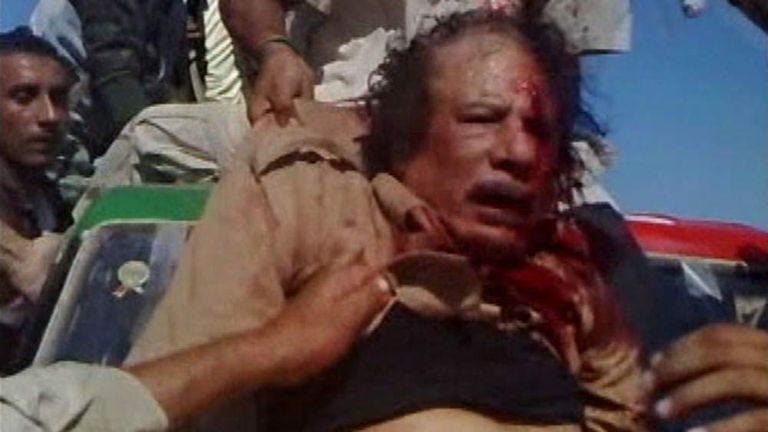
Gaddafi was captured, loaded onto the back of a truck, humiliated, brutally sodomized with a bayonet, and then finally shot several times as he pleased for his life – all to the joyous yells and cries of “Allahu Akbar”.
Four years later, and, rather like in Iraq, ISIS have now filled the vacuum left behind in Libya, with many participants of the uprising now showing signs of both remorse and regret, and some even giving in and echoing those ironic, lonely words: “Life “as better under Gaddafi”.
In a further twist, the rise of Islamic extremism also boosted the fact that many of the regimes weakened or deposed by the Arab Spring were among Washington’s most effective counterterrorism partners. Thus the like of Al-Qaida, ISIS, Boko Haram, Al-Shabaab, and endless other Islamic terrorist organisation have been able to grow and expand their influence at an alarming rate, with 11 major terrorist groups being added to the U.S. list of foreign terrorist organisations since the Arab Spring.
The idea that revolutionary uprisings in the Muslim world might open the door to terrorists was well recognised by analysts such as Juan Zarate, a senior advisor at the Centre for Strategic and International Studies. “The chaos and disappointment that follow revolutions will inevitably provide many opportunities for al-Qaeda to spread its influence” he predicted in April, 2001. “Al-Qaeda’s leaders…know that this is a strategic moment. They are banking on the disillusionment that inevitably follows revolutions to reassert their prominence in the region”.
Twelve years later, on the 5th August, 2013, Zarate warned that “We are now at risk of failing to imagine how the terrorist threat may be changing – well beyond the exclusive al-Qaeda prism”.
In the first nine months of 2014 alone, nearly 13,000 terrorist attacks claimed the lives of more than 31,000 people across the world. “
Far from fading away following the so-called war on Terror, al-Qaeda’s legacy has only grown”, says William Braniff, Executive Director of the National Consortium for the Study of Terrorism and Responses to Terrorism (START), at the University of Maryland, America. “It is clear that groups generally associated with al-Qaeda remain the most lethal groups in the world, and it is their violence that has driven global increases in activity and lethality”, Braniff reported in February, 2013.
Around half of the terrorist attacks and fatalities occurred in just three countries: Iraq, Pakistan, and Afghanistan; Muslims killing other innocent Muslims whom they don’t believe are ‘Muslim enough’. It is a tragic, hugely overlooked trend that still persists to this day.
In general, the movements associated with the Arab Spring, and particularly their impact, have faded from the public consciousness, perhaps partly due to the fickle temperament of the news media, perhaps because most westerners fail to acknowledge the Arab Spring or see it as anything that could possibly affect their own lives.
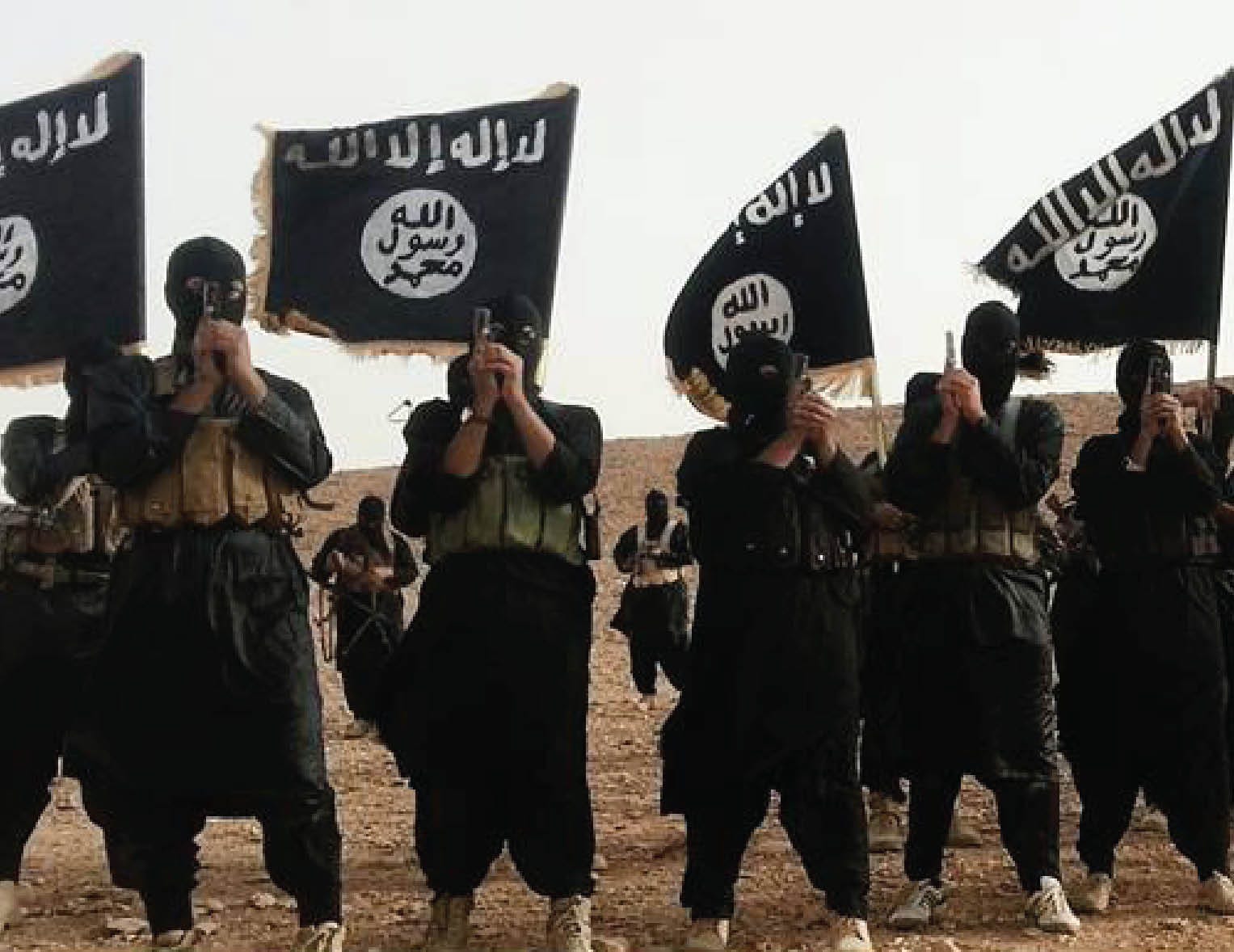
But from the black smoke of the Arab Spring appeared something that would inevitably stir the collective consciousness once more. ISIS.
It is quite easy to forget that ISIS – though heavily influenced by organisations like al-Qaeda – was born of the Arab Spring just as the new governments of Egypt and Tunisia were. The current chaos in Syria (a country that joined the Arab Spring revolution in 2011) can also be pinned in part to the uprisings, with different factions fighting for and against President Assad’s regime creating fertile ground for Islamists such as ISIS to flourish.
Yet even as the Middle East burned away into (in some instances) a no-man’s land, opportunist Jihadists across the globe – who each shared in the Islamist ideology of one day living in a world dominated by Islam and Sharia – still saw Europe, one of the modern world’s most key strategical and politically-significant countries, as a pivotal target for future conquest.
But to those wise amongst them, it was becoming clear that – through a swing to left-wing politics, political correctness, mass immigration, a weakened, almost hollow respect amongst the people for their own national identity, a rapid increase – both presently and predicted – in Muslim babies being born in member states such as Britain, France and Germany, a national security-damaging refugee crisis, radicalisation, and home-grown and imported terrorism, the Muslim conquest of Europe would most surely take care of itself.
For now, all that needed to be done was to continue to instil terror into the hearts and minds of the Kufr of the West, particularly citizens of Britain and America, both at home and abroad.
Five years after the intensity of the revolution in Tunisia, a series of overwhelming street demonstrations and public acts of protest that attempted to restore democracy, end corruption, crippling employment and social inequalities, and that would lead to the eventual overthrow of the Ben Ali government – Tunisia and its people still found themselves beaten down and blighted by severe financial problems and political unrest.
It was in this weakened, confused state, that terrorism began to quickly and dramatically increase.
On the 18th March, 2015, the country’s Bardo National Museum – a highly decorative building that stands proudly in the palm-studded capital, was attacked by three Jihadists, leading to the brutal deaths of 22 people.
ISIS were quick to claim responsibility, even threatening further attacks. The Tunisian government at the time, however, blamed a local splinter group of al-Qaeda in the Islamic Maghreb (a Wahhabi/Salafist Islamist Militant organisation) still at large and working hard in the hope to undermine and one day overthrow the government of Algeria, replacing it with the institution of an Islamic State.
Yet despite growing violence and political instability, the Tunisian government – whose unofficial key concern was in restoring and protecting the lucratice tourism industry that props up the Tunisian economy – made the irresponsible decision to declare the popular tourist trap as being safe and secure to visit, and – with big smiley faces – issued a formal, clear, and at the time much welcomed message to the rest of the world: The sun is shining, the waves are calm; Tunisia is back open for business…
***
26th June 2015.
The 5 Star Riu Imperial Mariana Hotel. 10km North of Sousse, Tunisia.
Rows of thick white plastic sun loungers face the glistening ocean like front-row seats at a theatre. A few of them have been intentionally moved just a little askew; a fraction closer into the direct line of sunlight, for that extra-special holiday tan.
Kneel beside one, avoiding the condensation-dripping cans of coke and bottles of factor 15 laying in the sand at your feet, and you would see all the layers of a perfect vacation. A casual wall of browning toes. A non-invasive scattering of adults and children playing in the sand and surf in front. A brother and sister building a sand castle. A newly-wed couple all clingy and giggly in the calm shallows.
A young man - dark hair, shorts and sandals - is smoking a cigarette and making a phone call to a loved-one on his mobile phone as he gazes out peacefully to sea.
The man on the other end of the line is the young man’s father.
But this isn’t just a catch-up call; one of those “it’s hot as hell here”, “you should try the shrimp down at the harbour” types. Something terrible is about to happen; something inhuman, unnatural, wicked. The young man knows it. He knows it because he believes that he has been sent by Allah to unleash it.
Pain, horror, heartache; all will explode in just a few short moments. But not until the beautiful sea, the warmth of the sun, and the blueness of the sky have been admired for just a little longer. Not until he finishes his final phone call.
Whilst we will possibly never know what words the 23-year-old electrical engineering student (who had spent the past half an hour mingling and blending-in with tourists) chose to exchange with his father, we can be reasonably certain that they didn’t convey any signs of regret, no sentiments of remorse or last-minute apologies. He was on a holy mission; a Jihad that he belted would grant him eternal joy and reward in the afterlife.
38 people would die in the process. 30 of them would be a British tourists taking in the same beautiful skyline as he was.
Saying his final farewell and ending the phone call, the young man, Seifeddine Rezgui, an adolescent who enjoyed hip-hop music and line dancing, had walked daily to a mosque in a poorer area of town because the preacher there was more ‘radical’ than that at the mosque just a few doors down from the flat he shared with four other young Muslims, and who got involved with an Islamic student union with strong ties to the Muslim Brotherhood, wrapped his fingers around his mobile phone, pulled his arm back behind his head, and tossed it, as hard and as far as he could into the sea.
He paced the shore for a few minutes, smoking the cigarette down to the butt before dropping the last burning paper cinder into the sand. He then strolled over to the parasol he’d brought with him, pulled out some grenades and a concealed AK47, and slung it over his shoulder.
A small crowd of tourists begin to gather behind him out of curiosity, watching him as he casually walks down the beach, passing an inflatable children’s pool toy in the shape of a killer whale. He looks down at the sea as it laps up against his toes, and then, with a big grin on his face, he turns around to face the rows of fun-loving beach dwellers - young and old - and opened fire.
Cheryl Mellor from Bodmin, Cornwall, was on the beach with her husband that day, sunbathing just feet away from the terrorist as he began casually gunning-down holidaymakers and their families indiscriminately.
He husband, Stephen, didn’t make it out alive.
“The initial blasts were really close” she recalled, going on to detail how they could see the gunman as clear as day as he stood at the edge of the sun loungers.
Her husband Stephen was by now on the ground beside her, telling her that he loved her and making a pact that if one of them should survive that they’d tell their children how much the other loved them.
From her cowering position, Cheryl could see the feet of a young female who was laying nearby.
“I heard a shot” she said, “and saw her foot jump, and assumed she’d been shot dead”
“I believe he was working to a plan” she added. “He was killing mainly British tourists”.
The couple had been looking forward to retirement. Now, as the gunman made his way down the rows of sun loungers, killing anyone he could, they were faced with imminent disaster.
“He looked right at us” said Cheryl, “and seemed to enjoy looking at us squirm”.
He then pulled the trigger.
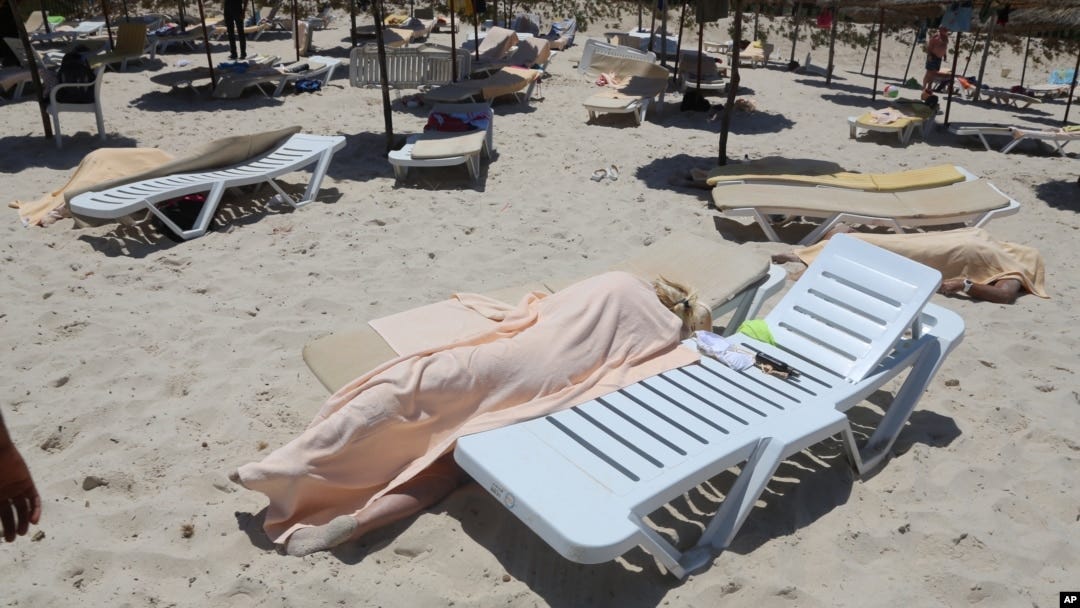
Cheryl felt her husband against her, protecting her the best he could as bullets tore into his chest and abdomen.
With Stephen dying in the sand beside the loungers that just moments ago he and his wife had been enjoying the sunshine on without a care in the world, Cheryl sobbed and waited as the Jihadist pressed-on.
Another woman was covering helplessly a few rows down. Cheryl gasped in horror as she watched the gunman aim his rifle at her, listened to her plead with him, screaming out “please, I’ve got family!”, and then spraying her with bullets.
There was a sound, Cheryl recalls, “like fireworks”, and “the smell of molten burning metal and a big orange cloud” spewing from the searing hot gun as it reeled-off round after round.
Content with his work on the beach and the whimpering casualties and pools of blood he’d left behind, the young killer strolled off up the sand, headed through a large gate, through a well-pruned garden, and straight towards his next target: a 5 Star Hotel packed-full of tourists.
“He wasn’t rushing around” Cheryl would later chillingly recount. “He wasn’t excitable. He just appeared to be calm...”
Just a stones throw away from the beach, upstairs in their fancy room on the second floor of the Riu Mariana Hotel, 50-something British couple Shirley and Joseph (Joe) Church were getting ready for their afternoon ritual.
The pair had decided to splash out on a holiday in Tunisia to escape the tiresome daily humdrum chores and routines of life back home in England. This was THEIR holiday, just the two of them; and they’d earned it. Both of them were grafters in their own right; Joe was an agricultural farm worker, and Shirley a cater for the elderly and part-time cleaner.
Joe and Shirley live just 8 miles of Peterborough in Thorney - a beautiful Cromwellian-esque village with slate and thatched roofs.
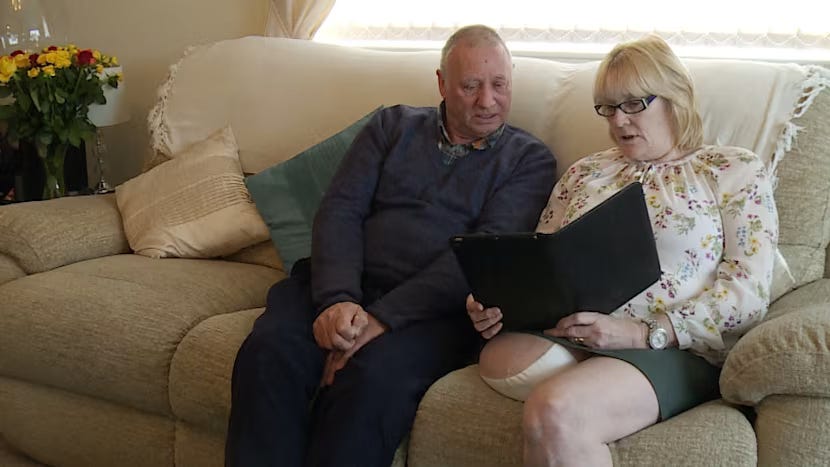
“Tunisia was a last minute decision” Shirley told me during a telephone call I’ll never forget. “We went into the travel agents and looked at all the different places, and the girl from Thomson told us that it was safe and nice there”.
Shirley and Joe booked their 14 day vacation in in the spot, and now, almost at the end of their time in Tunisia, the couple were taking full advantage of their little paradise; how comfortable and elegant the hotel was, how beautiful a view it afforded being located slap-bang on the seafront. The fresh air. The sun beaming down through the window as they finished getting dressed, checking they had everything, checking they had their room key, and then heading out.
During their time in sun-soaked Tunisia, Joe and Shirley had - as Brits regularly do - developed a semi-routine to form the backbone of each day.
Joe would always go down to the beach first thing in the morning. Shirley would then often go down after him a short while later to wrangle him back to the hotel for breakfast.
In between and after would consist of whatever they felt like doing if they hadn’t already made plans the night before. A swim. A lazy day by the pool. A stroll and a bite to eat somewhere local.
Today was no different.
After leaving the beach with some holiday pals and returning to the hotel for a departure meeting organised by a rep, the two were informed that the meeting had been rescheduled for later that day, and so their temporary friends invited them to come and have a nosey of their suite.
“We went and had a look around” Shirley told me, “then they [their friends] went shopping, so we decided to get ready and go back down to the beach. We walked down to the corridor and got to the lift”.
The lift down to the foyer was glass-fronted and, usually, the view was a crisp, pleasant one. Today’s however was much different.
“As soon as we stepped into the lift we could hear screaming” Shirley told me, her voice tired and crackling unaided down the line as she began to go into great detail of how, in the blink of an eye, her life was irreversibly changed forever.
“We could see everything- people running, shouting, yelling, panicking, and then of course, there was the gunfire”.
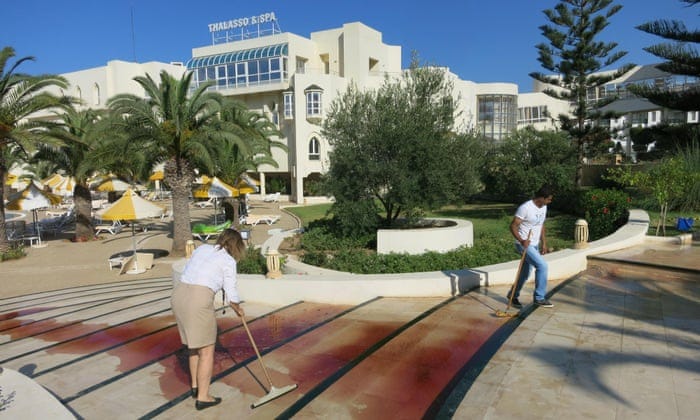
They had already started to descend. The doors were shut. The lift was in motion. There was no turning back. All they could do now was wait, confused and panic-stricken as they gradually reached what could easily have been mistaken as a check-in point for Hell. Waiting for them, firing away merrily in a cocaine-fuelled euphoria as he used up the last of his rounds, was the young Jihadist from the beach.
With the gate connecting the beach to the hotel left unlocked, the radicalised 23-year-old was able to simply stroll up unchallenged through the garden, shooting and killing anyone he came across along the way, and to walk right through the pool-side door of the Riu Marhaba Hotel, and into the reception area.
“If he’d have come just half an hour or so later” Joe told me disparingly “he’d have had an absolute field day”.
“Everyone was still running and screaming and panicking as we left the lift” Shirley continued. “We just followed the crowd. Everyone was running for the fire exits, so we started running with them. I could hear gunshots behind us and saying ‘oh my God, we’re gonna die’. My legs went to jelly.
Then, as the Jihadi started to catch up with us, people were scrambling into offices, anywhere where they could find a door. At that point me and the husband got parted.
While I was in the corridor running, suddenly it felt like something hit me on the back. When I eventually opened my eyes I was on the floor facing the opposite way in the biggest pool of blood you ever did see; head against the wall. Then I started to notice that I couldn’t move my right leg”.
Shirley panted in agony as she yelled out desperately for her husband.
“Next to me against the wall was an injured woman with a fractured femur. I just sat there bleeding to death. Another 2-3 minutes and I knew I’d be dead.
With her memory of that moment still a blur due to her life slowly draining away, at this point of the interview she passed me over briefly to her husband Joe, for him to fill in the blanks.
“She just slipped out of my hand” he told me sadly, his voice warm and local. “I must’ve only been away from her for two minutes or so. Inside the room I managed to get into there was a dead girl lying on the floor by a dresser. I stared at her lifeless body in disbelief. Then I heard her [Shirley] shouting, rushed back outside, and the first thing I saw were all the dead bodies scattered up the corridor”.
Rushing over to his heavily injured wife, the first thing that Joe noticed was just how serious the situation was.
Shirley was bleeding out. The strike to her back that she had felt before waking up facing the other direction had in fact been the blast from a grenade.
As scores of terrified tourists fled to the many rooms and fire exits in search of escape or shelter, ‘Sef’ as was the Jihadist’s nickname, Emily made sure that as many of them as possible were greeted by one of the grenades he’d brought along for this very purpose.
Seeing his wife fading away before him, Joe knew that he had to get help. “He was trying to shout for help through a blown-out window” said Shirley. “Eventually two paramedics turned up, searching for people to help. They walked up to us in their white coats but didn’t know what they could do for me. They just looked at Joe, looked back down at me, and then walked away”. Obviously, upon first glance, Shirley was a lost cause.
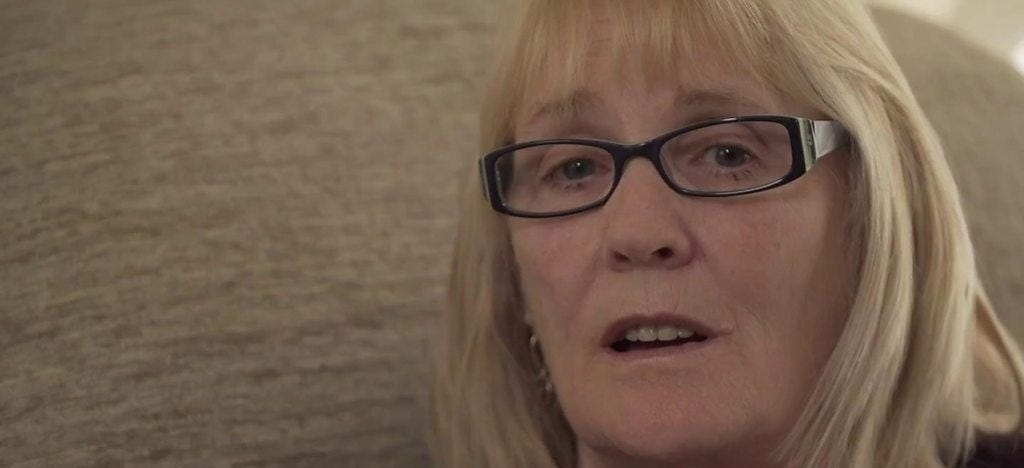
In that moment of despair, the husband and wife - both proud grandparents from Thorney - began to come to terms with the stark reality that Shirley wasn’t going to survive.
Picking up his mobile phone with trembly hands, Joe made a call to his eldest son.
There was no answer. He scrolled frantically through his contact list and tried his youngest son instead.
As I asked Joe the delicate question of what he’d said to his son in what he believed might be Shirley’s final moments, his voice began to quiver, and he quickly broke down.
“He answered the phone and I just said: I’m sorry” he told me, his sons making the hairs on tiny arms stand on end. “I just told him that I was sorry and that I didn’t know if he’d ever see his mum again”.
Meanwhile, seeing that there was no more ‘fun’ to be had in the hotel, Sef decided it was time to make his escape. He ran past the neighbouring Hotel Roy Bellevue and up a side alley, still armed with his AK47 and reportedly still clutching his last grenade.
At around 12:30 local time, a nearby builder, Mayel Moncef, spotted Rezgui from his rooftop vantage point and hurled a pile of tiled down on his head.
Sef - who had by now brutally stolen 38 innocent lives - turned and fired wildly across the street, narrowly missing police officers who by now had finally caught up with him.
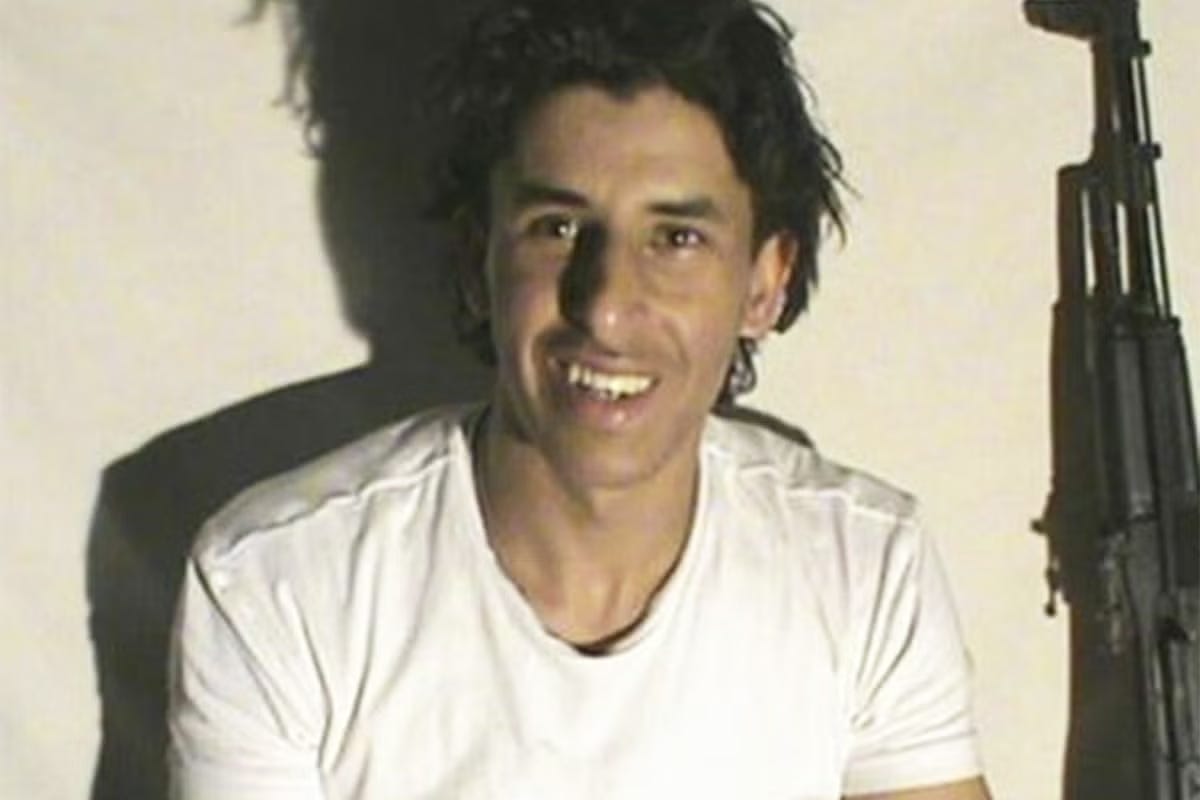
A single retaliation shot rang out - a crack and a zip that echoed down the street. Sef fell to the ground, killed instantly.
Back at the still-smoke-filled hotel corridor, just as Shirley was certain that she was about to die, some brave workmen turned selfless vigilantes found the couple huddled together by the wall.
“They carried me downstairs in a sunbed” Shirley told me. “I was loaded into an ambulance and taken off to hospital. From what I remember they stitched my gaping holes up after removing a load of shrapnel. But even then the doctors and nurses didn’t really know what to do with me”.
Shirley was flown back to England the next day, spent a few days having lifesaving surgery in Peterborough City Hospital, before eventually being transferred to Stanmore, a hospital generally known for specialising in the effective treatment of soldier amputees.
“Shrapnel from the explosion had cut straight through my sciatic nerve on my right leg” she said. “In Stanmore they tried to repair it and I had to go back and forth for ongoing treatment”.
Sadly, despite their best efforts, Shirley’s leg wounds proved to be far too severe.
“My right leg was stone cold” she said. “It’s turned itself onwards and a doctor finally told me that there was nothing else that could be done for the nerve. I’d have to have my leg amputated”.
It was perhaps the most surreal and devastating moment of her life.
In the days that followed the attack, Shirley became fixated on the news updates. By then, police and Intelligence agencies were able to establish that Rezgui had been working with the same Jihadist gang who had attacked the Bardo National Museum just three months before the Sousse attack, had been trained alongside one of the gunmen at an ISIS camp in Libya, and had links to an extremist cleric who had operated in England.
As predicted, ISIS claimed full responsibility for the terrorist attack, with a BBC Panorama investigation later revealing that the mastermind behind both attacks was one Chamseddine al-Sandi, who had paid for the attackers to go to Libya, had issued them their orders, and who had even arranged for Sef to be dropped off at the beach that morning.
Al-Sandi is currently believed to be in hiding in Libya. No great effort has been made to find him.
The ramifications of the attack in that fateful morning have - as with all terrorist attacks - been immense, and go far beyond just physical damage.
“It’s affected both of us” Shirley admitted. “Our anxiety levels are still through the roof, we can’t go on holidays anymore, have to avoid large crowds, loud noises. I can’t even just nip to the shops anymore either. Joe has to help me in my wheelchair”.
Joe - who was forced to pack-up work to become a full time cater to his disabled wife- was even more open with me about the impact that the Islamic terrorist attack has inflicted on his mental state.
“Before it happened I was bubbly” he said. “Now I just sit down and cry for no reason. It’s changed our entire lives. I hate big crowds. When we have to go into Peterborough town we make sure that we get there for 9am and leave by 9.30. We don’t stop anywhere for long now at all. And whenever we go out we’re checking everywhere to make sure it’s safe. I even sit in places like the hospital, looking everywhere thinking things like ‘why’s that bag there? Whys he acting strange?’. And every time we see a terrorist attack in the news it brings it all back. We can never get over it. We’ve just been left to learn to live with it”.
The husband and wife have also been hit financially.
“I had to pack up work” Joe told me, bravely unafraid to hide his sadness and frustration. “We’ve had no support, no compensation, and now after working all my life, just as I’m turning 64, I’m suddenly on just £62 a week carer’s allowance. What happened has made our life a living hell. We can’t do what we wanna do anymore. It’s destroyed our lives”.
“When we see Jihadists living here or coming back from fighting ISIS and being able to claim money on the social it makes me really cross” Shirley added. “No way should they be allowed to return to this country and put other lives at risk. It makes you wonder who the government actually care about”.
“No-one ever mentions anyone who survived - how they’re getting on, the struggles they go through every single day, physically and emotionally. But we’re here, alone, and the pain is going to be with us forever”.
Ironically, perhaps it can be said that no one has ever suffered more long-term misfortune than those who were lucky enough to have survived; to live on, to endure, with lifelong mental, often physical wounds and no real means nor hope (let alone help) to one day see them healed.
“I’ve just had another operation” Shirley tells me, “this time removing more shrapnel from my knee”.
I asked her if she often thought of Sef, the young student turned Jihadists who, through radical Islam and a will to do evil, had turned their world upside down.
“Some said he was smiling while he was doing it” she scowled. “But now he’s dead. I don’t even want to see photos of his face. He’s ruined my life. I was such an active person, now I’m just angry and frustrated. I get phantom pains in my leg where there’s now a stump, im on loads of painkillers clothes but I’m never painfree, ever, and never will be. I’m still full of shrapnel in both legs, my back, and in my hand. It’ll now stay there unless it ever comes to the surface”.