
FACT-CHECK: All of These Epstein/Trump Images are FAKE
Since the birth of the 'Epstein Scandal', social media has been awash with photographs of Epstein and his former associates. But not all of them are genuine.
You will undoubtedly have come across some of the viral images claiming to show President Donald Trump with Jeffrey Epstein or with children alleged to have been victims of a ‘trafficking operation’.
None of them are real.
Let’s jump straight in, with no sugar coating or unnecessary rambles…
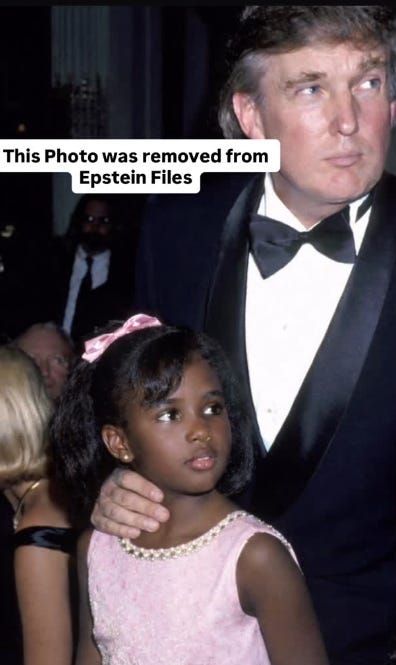
The above widely-circulated image claims to show Donald Trump with an unidentified minor. In reality, it is a photoshopped version of the below (real) photograph of Trump with his daughter, Ivanka.
Below, Trump is alleged to be kissing an underage girl, the image going viral, particularly on Twitter/X.
The image was in fact created by AI and is one of two versions that have been used by clickbait merchants and anti-Trump members of the public. Background faces are disfigured (a typical sign of AI generation), Donald Trump’s face in the image is clearly not his own, Epstein’s hairstyle is much longer than Epstein ever sported, and, mostly amusingly… Epstein not only has disfigured eyes, but he has no legs.
The below stills are taken from an AI-generated video that posters claim show Trump pointing at female children while walking with Ghislaine Maxwell. Look closely at the stills, however, and you’ll notice that the sideview of Trump’s face is highly distorted.
The video was generated by a prompt whereby the so-far unidentified creator requested for a moving image to be made based on the below (real) photograph of Trump with Ghislaine and socialite Ann Dexter-Jones.
The below viral images claim to show Trump kissing an unidentified female minor.
Using reverse-image search for both photos, the source of the top photograph is a Guardian article from March 2020.
Trump was judging the 1991 "Look of the Year" competition. The annual competition was run by the Elite Model Management agency under John Casablancas and was credited with launching the careers of supermodels like Cindy Crawford. Decades later, some of the models who participated in the competition made allegations of sexual harassment and abuse against Casablancas and the men in charge of the competition. But no allegations were made against Trump.
While the top image is genuine, the image claiming to show Trump kissing the girl is AI-generated using a prompt based on the harmless photograph of Trump talking to the girl. Below is another photograph taken of the event.
The below meme is frequently posted on social media, particularly on Instagram.
Using Google's reverse image search tool, no authentic news sources can be found that feature the image.
One indication that the photo is AI-generated is the unnatural hair and skin tone on the teenage girl, particularly the smoothness of the skin on her arm. Trump's armpit, where the girl's hand is placed, is unusually high.
Another indication stands out in the background of the image. The man behind the girl's shoulder appears to be holding the glass of alcohol with six fingers (including one invisible thumb), five of which are strangely elongated. The individual behind Trump's shoulder also has no visible ear lobe, despite the rest of the ear being in place.
Finally, Trump has blue eyes, as seen in these real mages. The AI-generated image shows Trump with brown eyes.
The above photograph was also generated with AI. The AI-detection tool Hive Moderation reported a 99.8% chance the image is AI-generated. It was thoroughly debunked when it originally circulated.
Again, the above viral image is AI-generated. And, again, Epstein has no legs. Below is another version of that fake image.
I don’t need to say much about the image below. Just look at the poorly-generated faces!
The below image often resurfaces during Epstein files updates. But it is entirely fake.
It is in fact a photoshopped version of the below (real) photograph of Trump with his daughter, Ivanka.
Below is a still from what some social media users claim to be a video showing Trump engaging in sexual activity with a young female. Captions insisting on its authenticity are frequently added, as shown in this example.
Some claim that the image below shows Epstein holding Melania Trump.
In reality, it is a (badly) photoshopped version of the below (real) photograph of Epstein and Ghislaine Maxwell.
Among the documents released by the DoJ are complete fabrications. A fine example comes in a letter reportedly written by Jeffrey Epstein from his prison cell to Larry Nassar, another high-profile sex offender. In it, Epstein allegedly writes that he and Nassar are kindred spirits who shared a passion for underage girls, that Donald Trump also shared this passion, and that he, Epstein, would soon be committing suicide. However, the letter has since been exposed as a forgery, with Mark Epstein confirming to me that the handwriting does not match his brother’s. The DoJ has since issued a statement reporting that they had found the letter to contain inconsistencies, such as the incorrect prisons listed for both Epstein and Nassar, and the letter being dated to a time when Jeffrey had already committed suicide. The author behind the hoax has not yet been identified. Nor has it been explained why the document was released, without context, despite it clearly being fake.
Below, a Twitter/X user with a large following claims that an Epstein victim said she was in possession of sex tapes of Donald Trump. Whilst his claim is true, it is based on an already-debunked lie.
Ransome, a former escort, met Epstein while in her twenties. Many years later, when the Epstein Scandal was in full-swing, she attempted to make money by telling journalists that she had sex tapes of Epstein, Donald Trump, Richard Branson, and the Clintons. Later, however, she admitted that she’d completely made up the story.
You can read my full shocking article about Ransome, along with death threats she sent to me, by clicking here.
The above part from a document is genuine. But the context has been removed.
It comes from a lawsuit once filed as part of a hoax.
The following comes from an article I wrote about that hoax:
For years, the anonymously filed allegation known as the “Katie Johnson” or “Jane Doe” lawsuit has drifted through the fringes of American political debate like a ghost no one quite knows what to do with. It appears, disappears, resurfaces, mutates. It’s invoked breathlessly by commentators who either never read the filings or don’t know how to recognise a synthetic story when they see one. And yet the documents are publicly available. The timeline is not complicated. The people behind it are not mysterious. If anything, the case is one of the most thoroughly debunked pieces of political theatre to have emerged from the 2016 election cycle. And when you step back and examine the entire structure — the pseudonyms, the dead-end addresses, the vanished plaintiff, the cancelled press conference, the character of the man who appears to have engineered the whole thing — you’re left with a picture not of a buried truth, but of a fabrication stitched together by a veteran tabloid trickster.
If the allegation had even a fraction of legitimacy, any one of the repeated federal filings would have progressed to discovery. But they didn’t. Instead, they were voluntarily withdrawn, dismissed, or exposed as procedurally defective long before they could be tested. And in the years since, not a single piece of new evidence has emerged to support the extraordinary claims they contained. What has emerged, instead, is a clearer understanding of who filed them, how they were assembled, and why they fell apart so quickly.
The accusation first surfaced in April 2016, when an anonymous woman identifying herself as “Katie Johnson” filed a lawsuit in California claiming that Donald Trump and Jeffrey Epstein had raped her when she was 13 years old in 1994. The filing had no attorney, no supporting documents, no credible witness evidence, and no verifiable identity.
DailyMail.com reported that ‘Katie’ had two DUIs and a felony drug possession on her record, along with a history of drug abuse.
Within weeks, it was dismissed for failing to meet even the minimal standards of federal civil procedure. The court attempted to mail the dismissal to the address Johnson had provided — and the letter came back as undeliverable. When journalists later traced the address, it turned out not to be a functioning residence at all, but a derelict shack in the desert near Twentynine Palms. That detail alone raised red flags. People filing genuine sexual assault lawsuits don’t generally provide vacant buildings as their home address. But the strangeness didn’t stop there.
A second version of the lawsuit appeared in New York federal court in June 2016, this time under the pseudonym “Jane Doe.” The complaint was similar but slightly refined, with two supporting statements from anonymous women claiming to corroborate Johnson’s allegations. But again, nothing about the filing resembled a legitimate civil action. There was no identification. No clear chain of evidence. No physical proof. And the supporting affidavits were impossible to verify — one was digitally signed, another allegedly provided by a “Tiffany Doe” whose role in the narrative seemed to expand and collapse depending on which version of the suit was filed. The details were inconsistent, and the tone of the documents read more like a script written for maximum emotional impact than a sworn legal complaint built on verifiable fact.
Then came the third filing, in September 2016, just weeks before the presidential election. This version was more polished, more elaborate, and backed by an attorney, though not one familiar with high-stakes federal litigation. But again, the case never reached an evidentiary hearing. No judge assessed the claims. No witness was ever cross-examined. No facts were tested. And before any of that could occur, the plaintiff abruptly withdrew the suit.
To understand why these lawsuits were taken less seriously by prosecutors and more seriously by tabloid journalists, you have to look at the man widely believed to have orchestrated and promoted them: Norm Lubow.
Lubow is not an anonymous figure. He is a former producer on The Jerry Springer Show — a program built on staged conflict and theatrical confession. He spent decades pushing sensational claims to tabloids. He inserted himself into celebrity scandals about O.J. Simpson, Kurt Cobain, and multiple Hollywood figures. He operated under aliases, most frequently “Al Taylor,” a name that surfaces repeatedly in connection with fabricated or exaggerated stories. Journalists have described him as a fabulist, a provocateur, a man who thrives on constructing narratives that collapse under minimal scrutiny. He is exactly the kind of character who might design a pseudo-legal hoax for maximum election-season impact.
And when the Guardian investigated the origins of the Trump–Epstein filing in 2016, Lubow’s fingerprints were everywhere. He contacted journalists posing as a representative of the anonymous accuser. He sent emails dripping with tabloid rhythms. He promoted the lawsuits directly to media outlets. And he appeared to be pulling the strings behind the scenes, shaping the narrative while hiding behind a rotating set of pseudonyms. If the allegation had been legitimate, its origins would not trace back to a man known for fakery. And yet that’s exactly where they led.
Journalists who attempted to meet the supposed accuser found only contradictions. The address didn’t exist. The phone number didn’t work. The plaintiff could never be located.
The most dramatic moment came in early November 2016, when a press conference was scheduled at the Los Angeles office of attorney Lisa Bloom. The event was heavily promoted. Reporters gathered. The cameras were ready. For the first time, the anonymous accuser was supposed to appear publicly, to state her claim in her own voice. Instead, Bloom walked out alone. The accuser, she announced, would not be coming. She had received threats, Bloom said, and was too frightened to appear. Within forty-eight hours, the lawsuit was voluntarily dismissed.
It is entirely possible, of course, that someone facing threats might withdraw a legitimate claim. But in this case, the threats were never verified, the plaintiff never materialised, and no follow-up action was ever taken. She did not refile after the election. She did not submit sworn testimony privately. She did not provide evidence to investigators. She simply vanished. Cases built on truth don’t evaporate like smoke the moment a spotlight hits them.
And this brings us to the heart of the matter: evidence.
There is no physical evidence supporting the allegation.
No documentation.
No contemporaneous report.
No witness testimony that has ever been vetted in a courtroom.
No real-world identification of the accuser.
No testimony under oath.
No confirmed timeline or corroborating detail that survives scrutiny.
Conversely, there is ample evidence pointing toward fabrication.
The plaintiff’s address was fake.
Her real identity and story could not be verified.
The case was filed three separate times by people who refused to identify themselves.
The filings changed details between versions.
The supporting statements were anonymous, unverifiable, and in some cases contradictory.
The man promoting the claims had a long and public history of hoaxes, hailing from The Jerry Springer Show, itself renowned for hiring actors to stage outlandish scandals.
The accuser disappeared immediately after the press conference collapsed.
And the dismissal came at the precise moment when journalists were beginning to expose inconsistencies.
If you were constructing a checklist of indicators that a case was manufactured, the “Katie Johnson” narrative would tick every box. It has all the structural markers of a politically timed hoax: late-season filing, anonymous plaintiff, tabloid-driven promotion, shifting details, unverifiable claims, a disappearance when scrutiny increases, and a promoter who makes his living fabricating stories for money.
This doesn’t prove what did or didn’t happen in 1994. It simply demonstrates that the lawsuits themselves are not credible vehicles for truth. Credibility is not subjective. It’s measurable. And on every measurable axis — evidence, procedure, identity, consistency, provenance, and longevity — the filings fail.
There is another fact worth noting. In the years since 2016, a number of Epstein-related accusers have come forward. A list of women. Countless lawsuits. Dozens of depositions. Investigations spanning continents. And through all of it — through the Virgin Islands litigation, the Ghislaine Maxwell trial, the civil suits, the financial settlements — not a single verifiable victim has ever accused Donald Trump or echoed the “Katie Johnson” allegation. Real victims know their timelines, their locations, their traffickers, the friends who saw them. Fake stories, by contrast, have no anchor in the world. They rely on vagueness, evasion, and the hope that no one will notice the empty spaces where facts should be.


For the Larry Nasser letter/postcard, it doesn't even require handwriting analysis to show that it's a fake/prank by someone in the public. The postmark is 13 August 2019, 3 days after Epstein died, and the location of the postmark is NOVA 220 - it was mailed from the Northern Virginia suburbs of DC. I'm sure who ever actually wrote it gets a kick out of the public thinking it's real.