


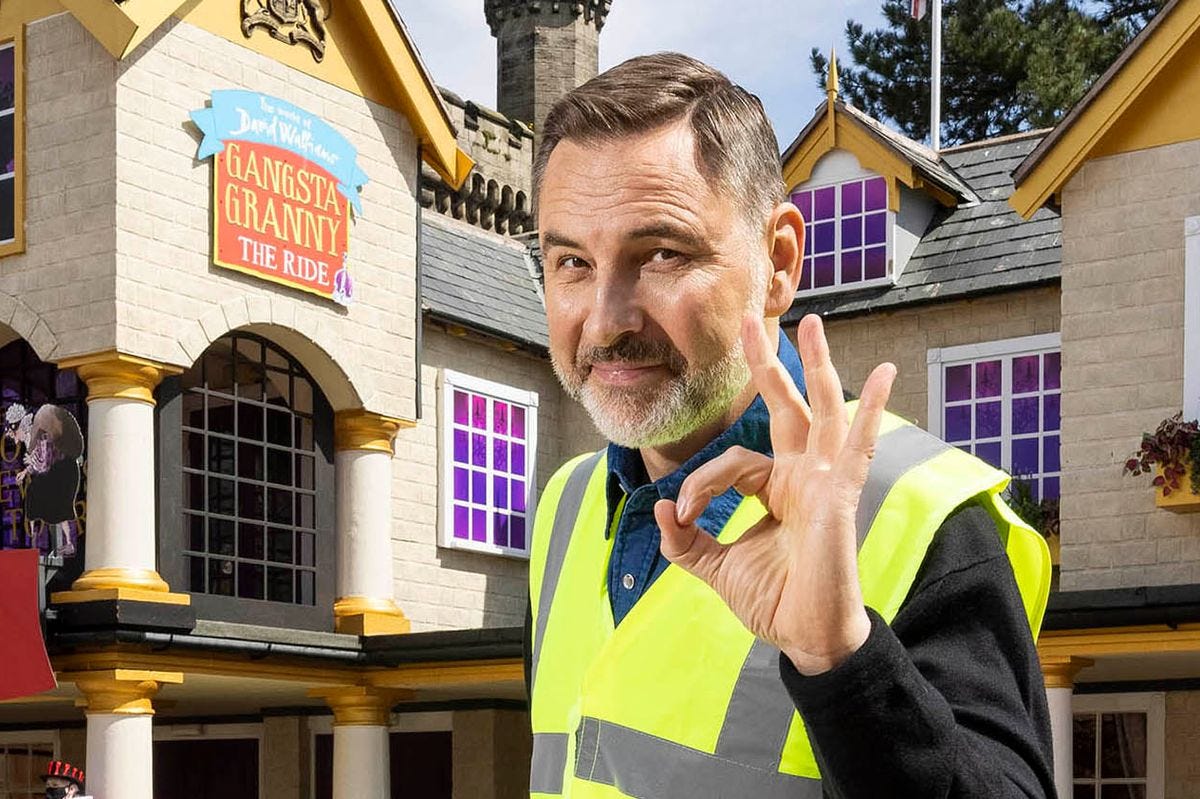
Last Tuesday, with the school holidays over and nobody much watching, Alton Towers quietly put a notice on its website. “The World Of David Walliams will be permanently closed from Tuesday, November 3, 2026.” And with that, Gangsta Granny: The Ride, Raj’s Bouncy Bottom Burp, the Royal Carousel, Raj’s Shop and the Burger Kitchen all vanished into the Staffordshire mist. Merlin Entertainments, the park’s owners, said the decision followed “our regular review of rides and attractions” and reflected “a range of operational and guest experience factors”. Nobody believed it then. A week later, nobody needs to.
Then, this Tuesday, ITV News and the Guardian published the results of an investigation they say took more than three years, and named David Walliams as the famous man who had spent the autumn in the High Court trying to stop them. Until then, he had been known only as an anonymous celebrity seeking an injunction, and a great many people on social media had been cheerfully guessing at his identity, mostly with no evidence at all. Some of them, it turns out, guessed right. That does not make what they were doing any less disgraceful. A man who flips a coin and calls heads has not demonstrated an understanding of probability.
Until this week, Walliams’s troubles amounted to an unpublished HarperCollins investigation into alleged inappropriate behaviour towards young female staff, a cancelled book contract, a pulped back catalogue and a theme park in mourning. None of the allegations reported until then concerned children. That is no longer the case, and there is no point pretending otherwise. What is alleged now is far more serious. It remains, however, exactly what it was then: allegation. And the way we have arrived here says as much about this country as it does about him.
So let us set out, carefully, what is being said, because the details matter, and because the headlines will not bother with them.
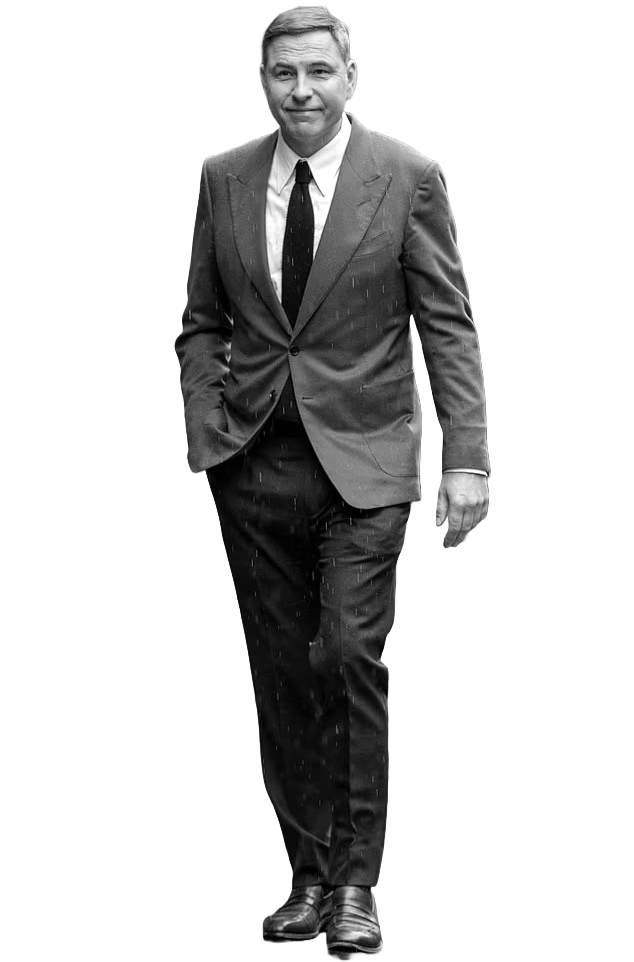
The investigation reports allegations from six women, dating back to 2003. Four are given pseudonyms; two, Lilly Creightmore and Abby Tomlinson, have chosen to put their names to their accounts. The most serious comes from a woman called “Jade”, who says Walliams contacted her on MySpace in 2007, when she was 15, met her in Soho and took her to his home, where she says he kissed her, touched her chest and tried to put her hand down his trousers. She says she refused, and that he told her to wait until she was 16. Walliams denies any sexual contact with her. If her account were true, it would describe a criminal offence. The Metropolitan Police says it has not received “any related reports of sexual assault or any other offences”, although it has contacted ITN and the Guardian to make sure the women know how to report. So nothing has been tested by anyone with the power to test it.
A second woman, “Alex”, says she met Walliams at a Little Britain book signing in 2004, when she was 15 and he was 32, and that he groomed her over the following years with phone calls, emails and gifts. She says he asked her for sexual photographs in 2005, and that they had consensual sex on three occasions when she was 17 and 18. Walliams denies grooming her, says he does not recall the request for photographs, and says he is “mortified to learn” that their “brief, consensual relationship has caused her sadness”. The age of consent in this country is 16. Whether a relationship between a man in his mid-thirties and a teenager he met when she was 15 is merely distasteful, or something worse, is precisely the kind of question that should be answered by evidence, not by a newspaper’s choice of verbs.
The others are of a different order. Lilly Creightmore says that in 2003, when she was 18 and between homes, Walliams let her stay with him and repeatedly asked her to share his bed, and that he “crossed the line physically” at times, although they never had sex; he says he is “devastated” by her account. “Ella” says that in 2007, when she was 19, he tried to kiss her at a party at his home, then lay his head in her lap and begged her to stay; he calls it a “clumsy pass” and denies the lap. “Sarah” says that in 2016, when she was 18, he invited her and a friend to stay at his London home and tried to kiss her; he denies making her drunk.
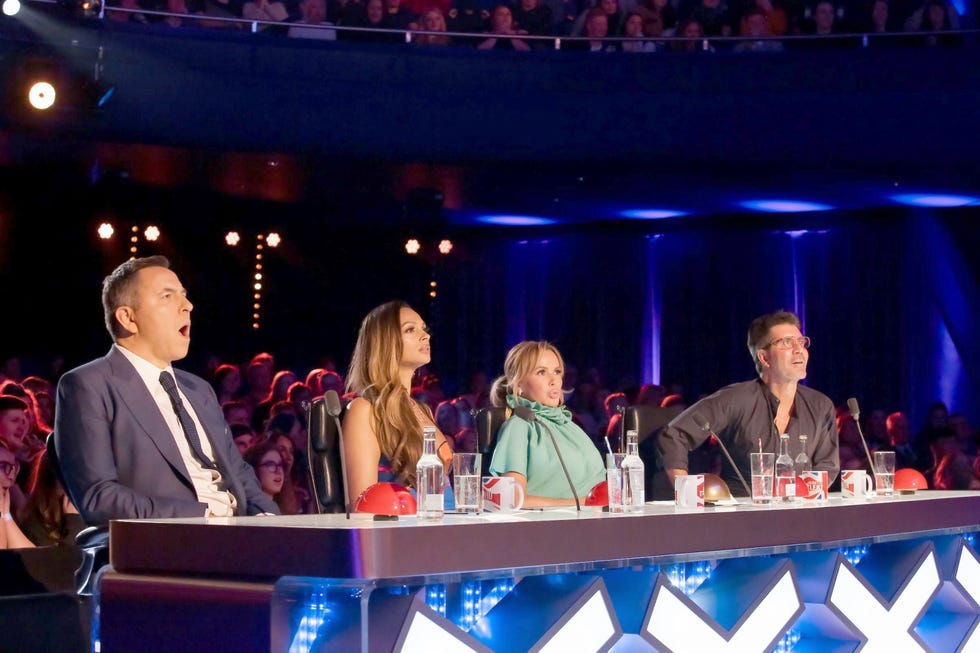
And then there is Abby Tomlinson, who turns out to be rather more than a former fan. She is the Prime Minister’s deputy director of digital communications, a senior aide to Andy Burnham in Downing Street. Readers with long memories may recall her as the teenager behind “Milifandom”, the online fan club for Ed Miliband in 2015. That same year, she says, Walliams sent her an unsolicited message on Twitter inviting her to watch Britain’s Got Talent. She was 17; he was 43. She took a 13-year-old friend, and says they were shown to his dressing room, where two other girls, aged 16 and 17, were already waiting, and that at one point she and the 13-year-old were left alone with him. “It was absolutely the case, the door was shut and we were alone with him,” she says. He had, she says, “a lot of access to young women, teenage girls”. In 2020 she posted on social media that he had invited her to meet him at 17, and later liked her Instagram posts and messaged her when she was 18 and 19. She does not allege that anything sexual happened in the dressing room. His lawyers say he was never alone with them, that the door “remained open at all times”, and now describe her account as misleading; a photograph shows her sitting at the judges’ desk with him.
I make no criticism of Ms Tomlinson for speaking, and she has had the courage to do so under her own name. But it is worth noticing where she works, because by Tuesday afternoon Downing Street had pronounced the allegations “deeply troubling”, and a justice minister, Alex Davies-Jones, had told the Commons that the government was “looking at what more it can do” about the use of injunctions. On X she went further: “Enough! Proud of all those victims refusing to stay silent.” Victims. Not complainants, not accusers: victims, of a man who has not been charged with anything, declared so by the government’s own victims minister, a member of the Ministry of Justice, on the day the allegations were published. If you wanted a single word to show how completely the presumption of innocence has collapsed, she has supplied it.
There are also claims from former colleagues. A former Britain’s Got Talent staffer says he once saw two “very young” people in Walliams’s dressing room while he was wearing only a towel, and that he was later given £300 in an envelope, which a colleague called “hush money”; Walliams says it was a tip. A former junior employee says he called her “the arse” and stared at her chest; he denies it. At HarperCollins, a former employee says she raised concerns about inappropriate emails to a junior colleague in 2015 and that nothing happened; another says staff agreed not to visit his home alone. And an intern was, the investigation says, sent to his house alone in 2017. Walliams admits that he had a sexual relationship with her.
His response, through his lawyers and in his own words, is unequivocal. “I am not a sexual predator,” he says. “I have not broken the law.” He denies all of the allegations, including any suggestion of criminal conduct, and his lawyers deny that his behaviour was any kind of “open secret”. He does concede something: “I realise I did not always take people’s feelings properly into account. That is something I regret.” But, he says, “abusing that power is something else entirely and it is something that I never did.” Fremantle, which produces Britain’s Got Talent, says that “no complaint has ever been made” to it, to ITV or to the regulator about his conduct. Syco says it “had no knowledge of the allegations”. HarperCollins says it does not comment on internal matters.
Then there is the court case, and the story behind it, which is where all this turns from grim to genuinely distressing.
In May, ITN and the Guardian sent Walliams letters setting out the allegations and asking for his response. That same evening, his team told them he had tried to kill himself. He was admitted, voluntarily, to a private psychiatric hospital, and publication was paused. His assistant later told the court she had seen an “immediate and marked change” in him after the letters arrived, and that “urgent intervention” was needed. Over the following months the journalists agreed several extensions to their deadlines. In July, his lawyers said, he left the hospital without permission and tried again. He was then detained under the Mental Health Act for assessment and moved to an NHS hospital for treatment. In September he was discharged, and for the first time formally denied the claims. In October, as the High Court heard his application over two days, he was sectioned once more. According to his barrister, Sara Mansoori KC, he had by then been examined by more than ten doctors, and he cited “long-term trauma and the fear of trial by media”. She told the court that he “has no intention of returning to public life”.
A court-appointed independent psychiatrist wrote three reports, finding “a genuine and serious underlying psychiatric vulnerability and an elevated baseline risk of suicide”. The expert did not conclude that suicide was inevitable, nor that treatment could remove all risk. One can argue about what that means. What one cannot argue about is that, in the space of six months, a man who was for a decade the most successful children’s author in the country went from his own home to a private clinic, to an NHS ward, to detention under the Mental Health Act, twice, before a single word of the allegations had been published. For the media, Gavin Millar KC said the allegations were the product of “a wide-ranging and rigorous investigation” in which reporters spoke to more than a hundred people, more than thirty of them with first-hand accounts, and that there was a “strong” public interest in publishing.
On 3 November, Mr Justice Nicklin dismissed the application in a 52-page judgment, ruling that an injunction would be an “exceptionally serious interference” with freedom of expression. He was careful to say that the ruling had nothing to do with whether the allegations were true. He did not doubt that Walliams was ill, and said his repeated statements that he intended to take his own life had to be taken seriously; protecting his health, however, was ultimately a matter for his doctors. But he found that the evidence did not “establish that suicide is inevitable”, that an injunction would not treat his condition, and that, because he was in hospital, the state had “assumed responsibility” for his immediate safety, which “materially reduces the likelihood of suicide”. “The evidence does not identify a point at which publication would become safe merely through the passage of time,” he wrote. Walliams was given permission to go to the Court of Appeal, with a deadline of 4.30pm on Monday. His lawyers confirmed that he would not. On Tuesday, the stories ran.
The collapse that followed took less than a day. The Labour Party suspended his membership. His agency, Independent Talent Group, said it was “no longer representing him in any capacity”. The BBC, calling the allegations “serious”, began removing programmes, Little Britain among them, from iPlayer and reviewing everything he had ever made or written for it. The producers of the film Fing! cut his cameo and said he would have no involvement in its release. HarperCollins had already pulped him; Alton Towers had already bulldozed Granny. Sky, for good measure, withdrew as the film’s UK distributor and removed content featuring him. There is very little left of David Walliams’s career to cancel, and he has not been charged with anything.
By Tuesday evening the story had acquired a whistleblower. The comedian Lucy Beaumont told Cathy Newman on Sky News that she was one of the people who had alerted the Guardian. It is worth listening carefully to what she actually said, because it was rather more honest than most of what followed. She does not know Walliams, has never worked with him, and has never seen him behave inappropriately. A young person in their first television job had told her they had been asked to take young women to his dressing room; the women, she said, were “definitely” over 16, but “he felt they were vulnerable”. She found one of the women, who was “in a really bad way”, and offered help, including paying the legal fees to get her out of a non-disclosure agreement; the woman declined. “I’m nearly crying,” Beaumont said. “She couldn’t talk to family, or friends, or her therapist.” She worried that speaking out would end her career: “Honestly, I don’t think I’ll work in telly again.” And then she said two things that I suspect will not make many headlines. She does not know whether the allegations are true. And: “I’m not the police. Nothing seems to be illegal.”
I do not doubt her good intentions, and her point that television has “no HR department” is a fair one. But notice what we have here: a sincere, concerned woman passing on what someone else told her about something she did not see, which she herself says may not have been a crime. That is hearsay, and in a courtroom it would be treated as such. In the court of public opinion it is evidence, and it will be treated as corroboration by a great many people who never heard her caveats.
I have no quarrel with the judge, who applied the law as it stands with obvious care. My quarrel is with the law as it stands.
For let us be clear about where David Walliams is today. He has not been arrested. No police force has said it is investigating him, and the Met says no offence has been reported to it. He has not been interviewed under caution, charged or convicted of anything. In the eyes of the law he is exactly as innocent as you or I. Not innocent until proven guilty, a phrase which assumes the verdict is merely running late, but innocent unless proven guilty. And yet, by Tuesday evening, his name was attached in every newspaper and on every phone in the country to the phrase “girls as young as 15”. Whatever happens next, whether he is ever charged, whether a jury ever hears a word of it, that is the sentence that will appear first when anyone searches his name for the rest of his life.
It is my belief, and I hold it despite being a journalist, or perhaps because I am one and have seen how the sausage is made, that the media should not be allowed to name someone accused of a crime until they have been convicted of it. Not charged: convicted. I know this is a minority view in my trade, and I know the objections, which I will come to. But consider what naming does. The moment an accused person is identified, the presumption of innocence ceases to have any practical meaning outside the courtroom. The story is no longer “did he do it?” but “what else did he do?” Every newspaper, every podcast and every bored teenager with a TikTok account becomes a prosecutor, and none of them is bound by the rules of evidence. Details are embellished, rumours are repeated until they sound like facts, and the denial is tucked into the last paragraph, like the small print on a payday loan. By the time any trial comes round, if it ever does, the jury has been reading about the defendant for a year. That is not a fair trial. It is a verdict waiting for a formality.
We have seen exactly where this leads, again and again. In 2014 the BBC filmed a police raid on Sir Cliff Richard’s home from a helicopter, live, as though it were covering a siege. He was never arrested, never charged, and eventually won substantial damages, but he has said the experience took years off his life. Paul Gambaccini spent a year on police bail, unable to work, before the case against him was dropped. Harvey Proctor lost his job and his home after being accused by the fantasist Carl Beech of belonging to a murderous paedophile ring; Beech went to prison for eighteen years, and Proctor got an apology from the Metropolitan Police, which he was unable to eat. Christopher Jefferies, a retired Bristol schoolteacher with unfashionable hair, was monstered by the tabloids as the murderer of his tenant, Joanna Yeates, so thoroughly that eight newspapers later paid him libel damages and two were found guilty of contempt of court. He was entirely innocent. Another man was convicted. Every one of these men was cleared. Not one of them got his old life back. The acquittal makes page eleven; the accusation is forever.
And there is a second point, which is even less popular, and which I will make anyway. If the accused is not protected, why should the accuser be?
In this country, anyone who alleges a sexual offence is entitled to lifelong anonymity, whether or not anyone is ever charged and whether or not the allegation is ever proved. The accused gets nothing of the kind. So we have an arrangement in which one party’s name, face and reputation are thrown to the public, while the other party’s identity is protected by law, and their claims cannot be fully examined by journalists without risk of identifying them. Most of the women in this case are pseudonyms: “Jade”, “Alex”, “Ella”, “Sarah”. I have no idea who they are, and nor have you. Their accounts may be entirely true. But nobody outside the investigation can check where they were, who else was there, what was said at the time and to whom, or whether their stories have changed over the years, which is precisely the kind of scrutiny that a named defendant’s every word will now receive. One side of the scales is weighed in public; the other is weighed behind a curtain.
I do not say this because I think accusers are liars. Most are not. I say it because equality before the law ought to mean equality. Either both parties are protected until a court has decided, which is my strong preference, or neither is. What we have instead is a system that protects the person making the allegation and exposes the person denying it, and then calls itself fair.
The objections are familiar, and serious, and I should state them honestly. Anonymity for complainants exists because, without it, many women would never come forward at all, given what happens to those who do. And naming suspects can encourage other people to come forward, which is how a number of genuine predators, Jimmy Savile among them, were finally exposed, alas only after his death. Those are real arguments. But the answer to them is not to abandon the presumption of innocence for some people and not others. It is to have police forces that investigate allegations properly, and courts that try them fairly, rather than leaving the job to newspapers, whose investigations, however rigorous, are not trials, and whose interests are not those of justice. The Guardian and ITN may well have done careful work here. They also have a story to sell.
None of this means that the women who have spoken to ITN and the Guardian are lying. Some of what they describe, if true, is serious, and if any of them wish to make a complaint to the police, they should do so, and it should be investigated properly, quickly and thoroughly. If David Walliams has committed a crime, he should be charged, tried and, if a jury is sure of his guilt, punished. That is how justice is supposed to work: both sides, the evidence, an impartial judge, a jury, cross-examination, and a verdict. What has happened instead is a trial by publication, in which the evidence has been gathered by journalists, presented by journalists and judged by readers, and in which the punishment, the loss of his livelihood, his books, his reputation, his corner of a theme park and very possibly his health, has been handed down before any court has considered whether he did anything wrong.
The mob, of course, is having a lovely time. Look at the comments under any story about Walliams this week and you will find very little concern for the women involved, and a great deal of glee. People who have never met him, never read his books and could not tell you the first thing about the allegations are queueing up to dance on his grave, swapping jokes about Gangsta Granny and Mr Stink, and “I always knew” from people who knew nothing. We like to think we have come a long way since the Colosseum, or since Salem and Pendle, where the accusation was the evidence. I am not sure we have come very far at all. We have swapped the arena for the timeline and the ducking stool for the hashtag. The crowd is bigger, faster and anonymous, and it does not even have to leave the house.
I do not know whether David Walliams did what he is accused of. Neither do you. Neither, in any sense that a court would recognise, do the journalists who published it. What I do know is that he is a man who has never been charged with anything, who denies everything, who has twice tried to take his own life, has twice been detained under the Mental Health Act and is now in a psychiatric hospital, and whose name is now permanently attached to allegations that no court has heard. If that is how we treat the accused, we should at least have the honesty to stop pretending that we believe in the presumption of innocence. And the crowd in the stands should remember that they will not always be in the stands.
Two tear accusers two tear victims two tear media two tear judges
Two tear sentancing